A
B
C
D
E
F
G
H
I
J
K
L
M
N
O
P
Q
R
S
T
U
V
W
X
Y
Z
Click a letter to see a list of conditions beginning with that letter.
Click 'Topic Index' to return to the index for the current topic.
Click 'Library Index' to return to the listing of all topics.
Surgical Treatment for Snoring and Sleep Apnea
The goal of most types of surgery for sleep is to widen the airway so you can breathe more easily. Surgery is done by taking out or shrinking excess tissue where the mouth meets the throat. Nasal and jaw surgery can help correct nose or jaw problems that lead to snoring and apnea. The U.S Food and Drug Administration (FDA) has approved several kinds of surgery for sleep apnea. Talk with your health care provider to understand your choices. The information below describes procedures that may be advised for you.
Uvulopalatopharyngoplasty (UPPP)
This is the most common surgery for sleep apnea. It trims the soft palate and uvula, and removes the tonsils and other tissue. It's major surgery done in a hospital. Most people go home within 24 hours.

Risks of UPPP
Problems are not common with this surgery. But risks include:
Laser-assisted uvulopalatoplasty (LAUP)
This surgery helps relieve snoring. It may also be used in some cases of mild apnea. The provider uses a laser or electric current to remove some of the soft palate and part or all of the uvula. This surgery may be done over several sessions in the provider’s office.
Risks of LAUP
The risks are the same as for UPPP, but less likely to occur.
Radiofrequency ablation (RFA)
This procedure helps relieve snoring. The provider uses radio waves to reduce the size of the turbinates or uvula, nearby tissue, and sometimes the back of the tongue.
Nasal surgery
Problems in the nose can make snoring or sleep apnea worse and also make a CPAP machine harder to use. A CPAP is a machine that sends mild pressurized air through a face mask to keep breathing airways open as you sleep. If blockages in your nose are severe, surgery can improve the airflow byreducing the size of the turbinates, straighten a crooked (deviated) septum, and remove any polyps. Polyps are overgrowths of sinus lining.
Jaw surgery
If your jaw sits too far back, your tongue may also be too far back. That makes your tongue more likely to block your airway when you sleep. Moving your jaw forward moves your tongue forward and widens the airway overall.
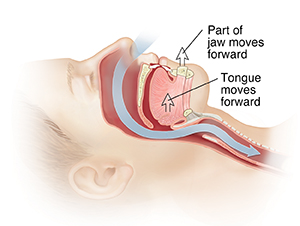
Risks of jaw surgery
In some cases, the jaw does not heal in the desired position. Your provider can tell you more about this. Other risks include:
-
Loss of teeth
-
Need for orthodontic treatment to realign teeth
-
Loss of feeling in jaw or teeth
-
Change in facial appearance
More severe cases
If your apnea is severe and no other treatment helps, other kinds of surgery may help. Your provider can tell you about them. One is hypoglossal nerve stimulator technology. This procedure implants a tongue pacemaker that stiffens and projects the tongue forward during sleep. Other surgery may focus on tongue muscles or bones in the midface.
Talk with your health care providers so you understand the risks and benefits of all procedures for snoring and sleep apnea.
Online Medical Reviewer:
Daphne Pierce-Smith RN MSN
Online Medical Reviewer:
Rita Sather RN
Date Last Reviewed:
3/1/2025
© 2000-2025 The StayWell Company, LLC. All rights reserved. This information is not intended as a substitute for professional medical care. Always follow your healthcare professional's instructions.